When buying or selling an older landed property in Singapore, the asking price and land size are only part of the equation.
For properties with redevelopment potential, another question matters: What can the land potentially become, and what will it cost to unlock that potential?
This is where the Land Betterment Charge (LBC) can become relevant.
From 1 September 2026, LBC rates for Residential Landed (Use Group B1) increased by an average of 3.5%. According to the Singapore Land Authority (SLA), 108 of Singapore's 118 geographical sectors saw increases of approximately 2% to 8%, while 10 sectors remained unchanged. SLA: Revision of Land Betterment Charge Rates from 1 September 2026
But what does this actually mean for landed homeowners, buyers and sellers?
In simple terms, Land Betterment Charge is a charge on the increase in land value arising from a chargeable consent, such as planning permission for development.
The important point is that LBC is not simply a 3.5% tax on the value of every landed property redevelopment.
The 3.5% figure refers to the average revision to the LBC table rates for landed residential use. Whether LBC is payable, and how much, depends on the specific development proposal and resulting increase in land value.
One of the easiest ways to understand the concept of "betterment" is through landed property subdivision.

Imagine a 400 sqm landed plot.
Before redevelopment:
400 sqm → 1 plot → 1 house
If planning controls allow the site to be subdivided and redeveloped:
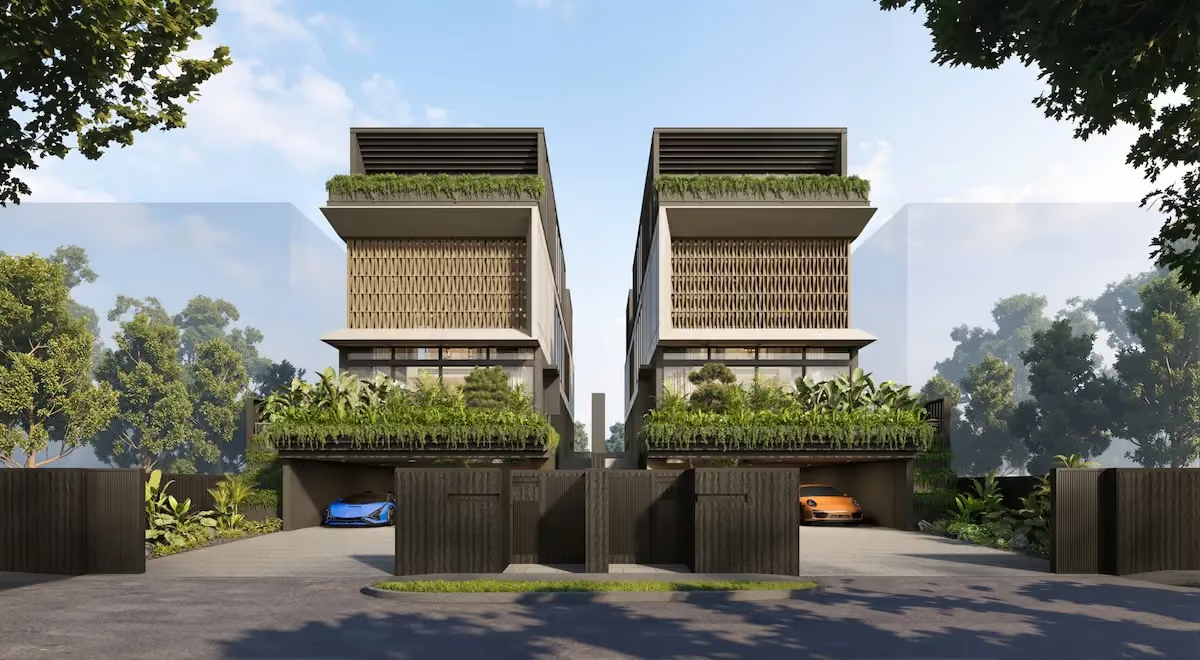
400 sqm → 2 plots of approximately 200 sqm → 2 landed homes
The land itself has not increased, but its development potential may have, potentially enhancing its value and triggering LBC.
However, subdivision is subject to URA planning controls and approval. For example, a side-to-side semi-detached house generally requires at least 200 sqm of land and 8m width per house.
This is why two landed properties with similar land sizes can have very different redevelopment values.
LBC rates are reviewed twice a year, generally taking effect on 1 March and 1 September.
For the period from 1 September 2026 to 28 February 2027, the average LBC rate for Residential Landed increased by 3.5%.


Consider Sector 93, covering areas around Still Road and East Coast Road.
For Residential Landed:
The S$420 per sqm difference, however, should not simply be multiplied by the entire GFA of every landed redevelopment to determine the LBC payable.
The actual liability depends on the relevant pre-chargeable and post-chargeable valuations and the specific development proposal.
Consider two buyers looking at the same older landed house.
Buyer A wants to renovate the existing property and live in it.
Buyer B sees the site as a redevelopment opportunity and is considering rebuilding or subdivision.
They may value the same property very differently.
For Buyer B, the purchase price is only one part of the calculation. Construction, professional fees, financing costs, development charges and potentially LBC all affect the project's feasibility.
This creates a potential chain effect:
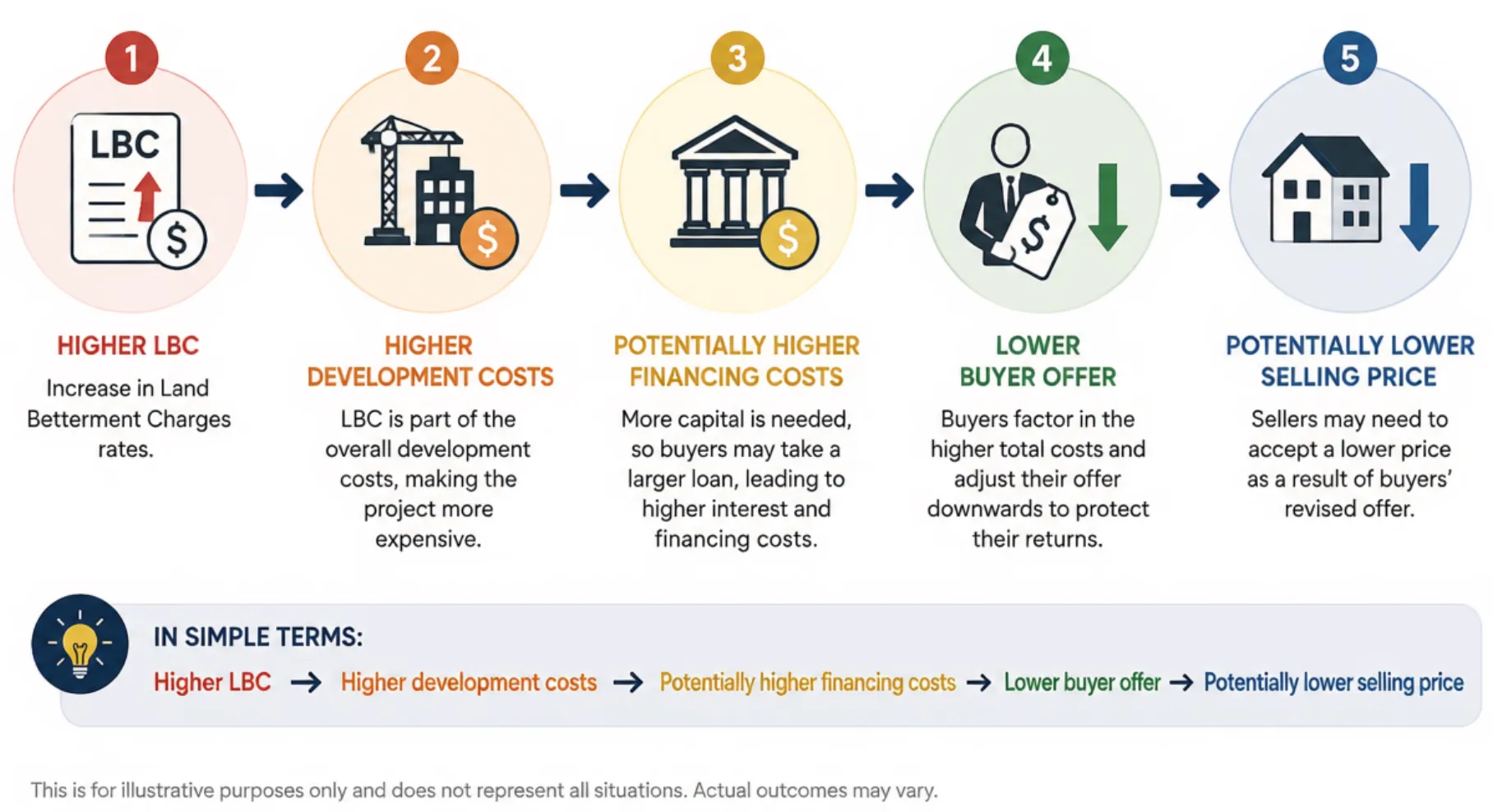
This does not mean that a 3.5% increase in LBC automatically causes landed property prices to fall.
A buyer may instead accept a lower development margin, modify the redevelopment concept or absorb the additional cost because the site remains attractive.
Ultimately, location, land scarcity, site configuration, redevelopment potential and buyer demand continue to play major roles in determining value.
In the landed market, it is common to hear:
"My neighbour sold at S$XX PSF, so my property should be worth the same."
Comparable transactions are useful, but land PSF alone can sometimes be misleading.
Two plots on the same street can have different values because of:
URA's prevailing planning controls set out requirements relating to matters such as minimum plot sizes, widths, setbacks and boundary clearances.
This means a property commanding a higher land rate may still be attractive if its configuration allows the land to be used more effectively.
Conversely, a seemingly attractive land PSF may not tell the whole story if significant redevelopment constraints or costs exist.
If you are buying an older landed property to rebuild, redevelop or explore subdivision, consider more than just the asking price.
Ask:
For sellers, the key question is:
Who is likely to see the greatest value in my property?
A property may appeal to:
Each buyer may assess the same property differently.
For an older landed home on a sizeable or well-configured plot, the land and its development potential may be more important than the existing building.
Understanding this potential before marketing can help sellers position the property towards the right buyer pool and better explain the rationale behind the asking price.
The latest LBC revision is a reminder that analysing a landed property in Singapore goes beyond comparing land PSF.
For a property with redevelopment potential, the more important questions are:
The 3.5% average increase in landed residential LBC rates may appear modest in isolation. But for a multi-million-dollar redevelopment, every component of the project's economics matters.
For sellers, understanding the development potential of your land can help you identify the right buyer and position your property more effectively.
For buyers, understanding the development potential and associated costs before making an offer can help you avoid overpaying for a site that may be more expensive to redevelop than it initially appears.
At PropertyGiant, we believe that the value of a landed property is not simply what's sitting on the land, it is also what the land can potentially become.
Land Betterment Charge (LBC) is a charge on the increase in land value arising from a chargeable consent, such as planning permission relating to development.
Not necessarily. Rebuilding does not automatically mean LBC is payable. Liability depends on the specific proposal and whether it results in a chargeable increase in land value.
Potentially. If planning approval allows one landed plot to be redeveloped into multiple landed properties, the additional development potential may enhance the site's value. However, subdivision is subject to planning controls and approval.
Can a 400 sqm bungalow plot automatically be subdivided into two semi-detached houses?
No. Minimum plot size is only one consideration. Plot width, housing form, site configuration and other prevailing planning controls must also be satisfied, and planning permission is required.
LBC rates are reviewed on a half-yearly basis, with revised rates generally taking effect on 1 March and 1 September.
No. The 3.5% figure is the average increase for Residential Landed use. Rates increased in 108 of 118 sectors by approximately 2% to 8%, while 10 sectors remained unchanged. SLA: September 2026 LBC Revision
Potentially. Where LBC forms part of a redevelopment proposal, a higher liability can increase project costs and influence how much a redevelopment-driven buyer is prepared to pay for the land. However, LBC is only one factor among many that determine market value.
Information and government rates referenced in this article are accurate as at September 2026.
Disclaimer: This article is for general informational and educational purposes only and does not constitute legal, tax, valuation, planning or financial advice. Land Betterment Charge liability, subdivision potential and redevelopment feasibility are site-specific and may vary according to prevailing legislation, planning guidelines, policies and approvals. Readers should seek advice from the relevant qualified professionals and government authorities before making property or redevelopment decisions.